

CPAP and BiPAP machines look almost the same: a bedside box, a hose and a mask. The difference is in the air. A CPAP blows one steady pressure all night. A BiPAP switches between a higher pressure when you breathe in and a lower one when you breathe out, which means it can help you breathe, not just keep your airway open.
That difference decides who gets which. This guide explains how each works, which one sleep medicine guidelines recommend for sleep apnea, when BiPAP is the right machine, how they are used in hospital for COPD and heart failure, and what insurance requires before it pays for a BiPAP.
Quick Answer
CPAP (continuous positive airway pressure) delivers one fixed pressure to hold the airway open. BiPAP (bilevel positive airway pressure) delivers two pressures, higher on the breath in and lower on the breath out, so it also helps move air in and out of the lungs. For ordinary obstructive sleep apnea, CPAP or auto-CPAP is the first choice, and the American Academy of Sleep Medicine suggests them over BiPAP. BiPAP is used when CPAP pressure cannot be tolerated or does not work, and for conditions where breathing itself is weak or carbon dioxide builds up, such as COPD with high CO2, obesity hypoventilation, ALS and some central sleep apnea.
In this guide:
- What CPAP and BiPAP Are and How They Work
- CPAP vs BiPAP: The Main Differences
- Which Is Better for Sleep Apnea?
- When You Need BiPAP Instead of CPAP
- Is BiPAP More Comfortable Than CPAP?
- CPAP vs BiPAP in the Hospital: COPD, Heart Failure, Asthma
- Is BiPAP More Serious Than CPAP?
- Insurance, Cost and Masks
- How to Know Which One You Need
- The Verdict
What CPAP and BiPAP Are and How They Work
CPAP stands for continuous positive airway pressure. The machine pushes room air through the mask at one set pressure, measured in centimetres of water (cm H2O). That pressure acts like an air splint: it keeps the soft tissues of the throat from collapsing during sleep, which is what causes obstructive sleep apnea. The pressure is the same whether you breathe in or out.
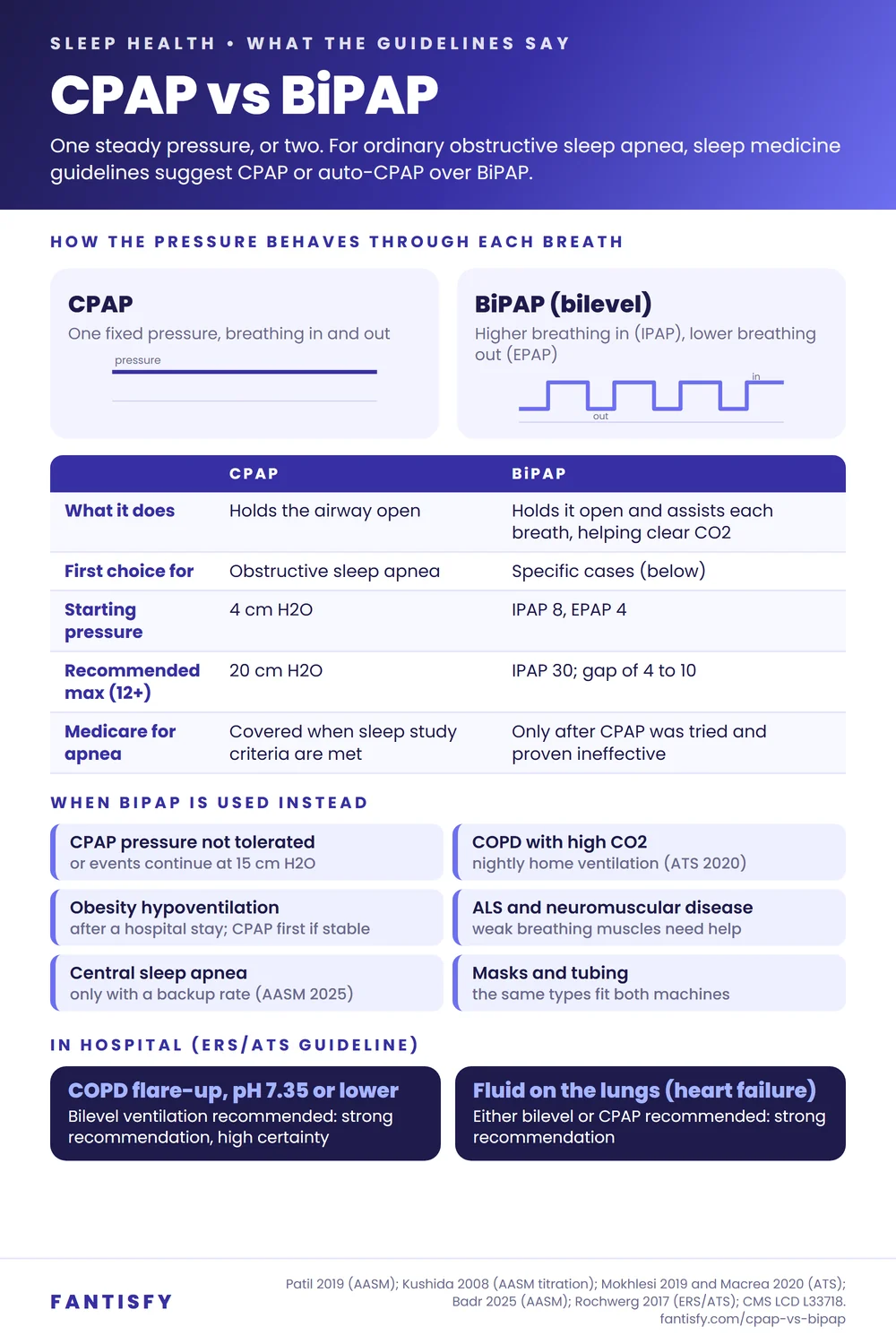
BiPAP stands for bilevel positive airway pressure. BiPAP is a Philips brand name; the general terms are BPAP, bilevel or BiLevel. It uses two settings: a higher inspiratory pressure (IPAP) when you breathe in and a lower expiratory pressure (EPAP) when you breathe out. The EPAP does the splinting job that CPAP does. The gap between the two, called pressure support, gives each breath a push, which increases how much air moves in and out and helps clear carbon dioxide.
Picture the pressure on a graph: CPAP is a flat line, BiPAP is a line that steps up with every breath in and down with every breath out. Some BiPAP machines also have a backup rate (often labelled ST, spontaneous/timed), which delivers a breath if you do not take one on your own within a set time.
APAP and ASV, the other two acronyms
- APAP (auto-CPAP) is a CPAP that adjusts its single pressure up and down through the night within a set range, raising it when it detects the airway narrowing.
- ASV (adaptive servo-ventilation) is a more advanced bilevel machine for central sleep apnea that varies the pressure support breath by breath to smooth out an irregular breathing pattern.
CPAP vs BiPAP: The Main Differences
| CPAP | BiPAP (bilevel) | |
|---|---|---|
| Pressure | One fixed pressure, in and out | Two pressures: higher breathing in (IPAP), lower breathing out (EPAP) |
| What it does | Keeps the upper airway open | Keeps the airway open and assists each breath |
| Main use | Obstructive sleep apnea | CPAP intolerance or failure; high CO2 (COPD, obesity hypoventilation); ALS and other neuromuscular disease; some central sleep apnea; hospital use for COPD flare-ups |
| Typical pressure limits (adults, AASM titration guideline) | Starts at 4 cm H2O; recommended maximum 20 | Starts at IPAP 8 and EPAP 4; recommended maximum IPAP 30; gap between them 4 to 10 |
| First-line for sleep apnea? | Yes (or auto-CPAP) | No, except in specific situations |
| Medicare coverage for sleep apnea | Covered when sleep study criteria are met | Covered only after CPAP was tried and proven ineffective |
| Masks and tubing | Nasal pillows, nasal or full-face masks | The same masks and tubing |
Which Is Better for Sleep Apnea?
For most people with obstructive sleep apnea, CPAP is better, or more precisely, a BiPAP brings no extra benefit. In its 2019 guideline, the American Academy of Sleep Medicine made a strong recommendation that clinicians use either CPAP or auto-CPAP for ongoing treatment of obstructive sleep apnea in adults, and suggested CPAP or auto-CPAP over BiPAP for routine treatment. The reason is simple: obstructive apnea is a problem of the airway collapsing, and one steady pressure fixes that. The extra push on each breath that BiPAP gives is not needed when breathing itself is normal.
Auto-CPAP and fixed CPAP are close. A Cochrane review of 64 studies with 3,922 people found that people used auto-CPAP about 13 minutes longer a night than fixed CPAP, from an average of about five hours, and that the evidence on other pressure changes, bilevel included, was too thin to draw firm conclusions. So a BiPAP is not a general upgrade for people who struggle with CPAP; it is a different tool for a narrower set of problems.
If you are still deciding whether you need a machine at all, our guide to whether sleep apnea can be cured covers weight loss, surgery and the other options.
When You Need BiPAP Instead of CPAP
These are the situations where guidelines and sleep doctors move from CPAP to bilevel.
You cannot tolerate CPAP pressure, or it is not high enough
The AASM titration guideline says a patient who is uncomfortable or intolerant of high pressures on CPAP may be tried on BiPAP, and that if obstructive events continue at 15 cm H2O of CPAP during a titration study, the patient may be switched to BiPAP. Breathing out against a lower pressure is easier for some people when the pressure needed is high.
Obesity hypoventilation syndrome
In obesity hypoventilation syndrome, extra weight makes breathing so shallow that carbon dioxide stays high even while awake. The American Thoracic Society suggests CPAP rather than bilevel as the first treatment for stable outpatients who also have severe obstructive sleep apnea, and suggests that people admitted to hospital with breathing failure who probably have the syndrome go home on noninvasive ventilation (bilevel) until they have a sleep study and pressure titration, ideally within 2 to 3 months.
COPD with high carbon dioxide
For people with stable COPD whose blood carbon dioxide stays high, the American Thoracic Society suggests nightly noninvasive ventilation in addition to usual care, screening for obstructive sleep apnea first, and aiming the settings at bringing CO2 down to normal. It suggests not starting long-term home ventilation during a hospital stay for a flare-up, and instead reassessing 2 to 4 weeks after recovery.
ALS and other neuromuscular disease
When the breathing muscles weaken, the machine has to do part of the work, which CPAP cannot. In a randomized trial in ALS, noninvasive ventilation improved quality of life and survival; in people whose swallowing and speech muscles still worked fairly well, the median survival gain was 205 days, with quality of life maintained for most of that time.
Central sleep apnea
In central sleep apnea the brain does not send the signal to breathe, so there is nothing for a steady pressure to splint. The AASM 2025 guideline suggests CPAP, bilevel with a backup rate, or adaptive servo-ventilation depending on the cause, and suggests against bilevel without a backup rate. That detail matters: a standard BiPAP without a backup rate is not the right machine for central apnea. ASV also needs care in heart failure: in the SERVE-HF trial of 1,325 people with heart failure and an ejection fraction of 45% or less, ASV raised all-cause death (hazard ratio 1.28) and cardiovascular death (1.34), so the guideline limits it in that group to experienced centres.
Is BiPAP More Comfortable Than CPAP?
For some people, yes, mainly at high pressures, because breathing out against a lower pressure feels more natural. That is why the titration guideline allows a switch for pressure intolerance. For typical sleep apnea at ordinary pressures, the trials do not show that bilevel makes people use their machine more, which is why it is not the default.
Before asking for a different machine, most comfort problems have simpler fixes:
- Mask fit. Leaks, dry eyes and sore noses are usually the mask. Try another size or style; nasal pillows, nasal masks and full-face masks suit different faces and mouth-breathers.
- Humidification. A heated humidifier helps a dry mouth and nose.
- Expiratory pressure relief. Most CPAP machines can lower the pressure slightly as you breathe out, a feature that makes CPAP feel closer to bilevel.
- Auto-CPAP. Lower pressure for most of the night, rising only when needed.
- Ramp. Starting at a low pressure that rises as you fall asleep.
Sticking with it is the real challenge with any machine. Across 82 studies over 20 years, about a third of people (34.1%) did not use CPAP enough, and the figure did not improve over time; behavioural support added about an hour of use a night. The AASM recommends education when therapy starts and suggests troubleshooting and remote monitoring in the first weeks.
CPAP vs BiPAP in the Hospital: COPD, Heart Failure, Asthma
In hospital and in ambulances, CPAP and BiPAP are both forms of noninvasive ventilation, given through a tight face mask instead of a breathing tube. The choice depends on the type of breathing failure:
- Low oxygen (type 1 respiratory failure): pressure opens up the small air sacs and improves oxygen levels. CPAP can do this.
- High carbon dioxide (type 2 respiratory failure): the lungs are not moving enough air. BiPAP’s push on each breath increases ventilation and helps clear CO2, which CPAP does not do well.
The European Respiratory Society and American Thoracic Society guideline sets out where noninvasive ventilation helps:
| Condition | ERS/ATS 2017 guideline |
|---|---|
| COPD flare-up with acidic blood (pH 7.35 or lower) | Bilevel recommended (strong recommendation, high certainty). Also a trial of bilevel before intubation unless the patient is rapidly deteriorating |
| COPD flare-up with high CO2 but normal pH | Suggests not using noninvasive ventilation |
| Heart failure with fluid on the lungs (cardiogenic pulmonary edema) | Either bilevel or CPAP recommended (strong); either suggested in the ambulance too |
| Asthma attack | No recommendation: the evidence is too uncertain |
| New low-oxygen respiratory failure (for example pneumonia) | No recommendation for noninvasive ventilation |
So the hospital rule of thumb is that BiPAP is the machine for COPD flare-ups with high CO2, either machine works for heart failure with fluid on the lungs, and neither is a standard answer for asthma.
Is BiPAP More Serious Than CPAP?
Not in the sense most people mean. Being put on BiPAP does not mean your sleep apnea is worse than someone on CPAP. It means your breathing needs more help than an open airway: carbon dioxide is building up, the breathing muscles are weak, or the brain is not triggering breaths reliably. Those conditions are often more serious than plain obstructive sleep apnea, which is where the impression comes from.
BiPAP counts as noninvasive ventilation because it assists breaths. CPAP is often grouped with it but does not actively assist breathing. Neither is a ventilator with a breathing tube, and neither breathes for you unless a BiPAP has a backup rate set.
Insurance, Cost and Masks
Medicare’s rules for sleep apnea show how insurers treat the two machines:
- CPAP is covered when a sleep study shows an apnea-hypopnea index (AHI) of 15 or more events an hour with at least 30 events, or 5 to 14 an hour with at least 10 events plus daytime sleepiness, impaired thinking, mood problems or insomnia, or high blood pressure, heart disease or a past stroke.
- BiPAP without a backup rate is covered for obstructive sleep apnea only if CPAP was tried and proven ineffective despite proper mask fitting and pressure settings.
- Keeping coverage requires use of 4 hours or more a night on 70% of nights in a 30-day stretch during the first 3 months.
Bilevel machines cost more than CPAP machines, which is part of why insurers want CPAP tried first. Private plans set their own rules, so check yours before buying. The masks, tubing and humidifiers are the same types for both, so a mask that fits you on CPAP will usually work on a BiPAP.
How to Know Which One You Need
A sleep study decides it. An overnight study, or a home test for straightforward cases, shows whether your apnea is obstructive or central and how severe it is. A titration, in a lab or at home with auto-CPAP, then finds the pressure that keeps your airway open. Tell your doctor if you have COPD, heart failure, a neuromuscular condition, or high CO2 on a blood test, because those change the choice.
Ask whether you need a change if, after a few weeks of real use:
- you still wake up gasping, snore through the mask or feel as sleepy as before;
- you cannot breathe out comfortably against the pressure, even with expiratory relief;
- you swallow air and wake up bloated, a common sign the pressure is high;
- your machine reports a high remaining AHI.
Do not change the settings yourself or swap machines without your sleep doctor; the pressure is a prescription. Sleeping position can also lower the pressure you need: see the best sleep position for sleep apnea. And if you are weighing whether treatment is worth the hassle, what untreated sleep apnea does to the heart is the case for sticking with it.
The Verdict
CPAP holds the airway open with one steady pressure; BiPAP adds a second, higher pressure on each breath in, so it also helps you breathe. For ordinary obstructive sleep apnea, CPAP or auto-CPAP is the standard and BiPAP adds nothing on average. BiPAP is the right machine when high CPAP pressure cannot be tolerated or does not work, and when the problem is breathing itself: COPD with high carbon dioxide, obesity hypoventilation, ALS and other neuromuscular disease, and central sleep apnea, where it needs a backup rate.
In hospital, BiPAP is the go-to for COPD flare-ups with high CO2, and either machine helps heart failure with fluid on the lungs. Whichever you are given, the result depends on using it every night, so fix the mask and the comfort settings before deciding the machine is wrong.
FAQs
Citations
Patil SP, Ayappa IA, Caples SM, et al. Treatment of adult obstructive sleep apnea with positive airway pressure: an American Academy of Sleep Medicine clinical practice guideline. Journal of Clinical Sleep Medicine, 2019. pubmed.ncbi.nlm.nih.gov
Kushida CA, Chediak A, Berry RB, et al. Clinical guidelines for the manual titration of positive airway pressure in patients with obstructive sleep apnea. Journal of Clinical Sleep Medicine, 2008. pubmed.ncbi.nlm.nih.gov
Kennedy B, Lasserson TJ, Wozniak DR, Smith I. Pressure modification or humidification for improving usage of continuous positive airway pressure machines in adults with obstructive sleep apnoea. Cochrane Database of Systematic Reviews, 2019. pubmed.ncbi.nlm.nih.gov
Mokhlesi B, Masa JF, Brozek JL, et al. Evaluation and management of obesity hypoventilation syndrome. An official American Thoracic Society clinical practice guideline. American Journal of Respiratory and Critical Care Medicine, 2019. pubmed.ncbi.nlm.nih.gov
Macrea M, Oczkowski S, Rochwerg B, et al. Long-term noninvasive ventilation in chronic stable hypercapnic chronic obstructive pulmonary disease. An official American Thoracic Society clinical practice guideline. American Journal of Respiratory and Critical Care Medicine, 2020. pubmed.ncbi.nlm.nih.gov
Bourke SC, Tomlinson M, Williams TL, et al. Effects of non-invasive ventilation on survival and quality of life in patients with amyotrophic lateral sclerosis: a randomised controlled trial. Lancet Neurology, 2006. pubmed.ncbi.nlm.nih.gov
Badr MS, Khayat RN, Allam JS, et al. Treatment of central sleep apnea in adults: an American Academy of Sleep Medicine clinical practice guideline. Journal of Clinical Sleep Medicine, 2025. pubmed.ncbi.nlm.nih.gov
Cowie MR, Woehrle H, Wegscheider K, et al. Adaptive servo-ventilation for central sleep apnea in systolic heart failure. New England Journal of Medicine, 2015. pubmed.ncbi.nlm.nih.gov
Rochwerg B, Brochard L, Elliott MW, et al. Official ERS/ATS clinical practice guidelines: noninvasive ventilation for acute respiratory failure. European Respiratory Journal, 2017. pubmed.ncbi.nlm.nih.gov
Rotenberg BW, Murariu D, Pang KP. Trends in CPAP adherence over twenty years of data collection: a flattened curve. Journal of Otolaryngology – Head and Neck Surgery, 2016. pubmed.ncbi.nlm.nih.gov
Centers for Medicare and Medicaid Services. Local Coverage Determination L33718: Positive Airway Pressure (PAP) Devices for the Treatment of Obstructive Sleep Apnea. cms.gov




Leave a Reply