

Your periods have started doing something new, you are waking at 3 a.m. for no reason, and somewhere online you found a list of 34 perimenopause symptoms that seems to include everything you have ever felt. Some of those symptoms are well documented. Some are not. And a few of them are worth taking to a doctor because they are not perimenopause at all.
This page sorts the list by what the research actually supports, mostly from the Study of Women’s Health Across the Nation (SWAN), which has followed more than 3,000 US women through the transition since the 1990s. It covers the two stages, how long each symptom tends to last, what treatment the evidence backs, and what it does not.
Quick Answer
Perimenopause is the transition before your final period, usually starting in your 40s. The symptoms with the strongest evidence are changes in your cycle (longer, shorter, heavier or missed periods), hot flashes and night sweats, trouble sleeping, low mood, a mild and temporary dip in memory, and fat shifting toward the waist. Hot flashes last a median of 7.4 years. If you are 45 or older, no blood test is needed to diagnose it. Hormone therapy is the most effective treatment for hot flashes, and several non-hormonal prescriptions also work; menopause supplements and herbal remedies have not been shown to.
In this guide:
- What Perimenopause Is
- The Two Stages of Perimenopause
- Perimenopause Symptoms List, Ranked by Evidence
- Hot Flashes and Night Sweats
- Period Changes: What Is Normal
- Sleep and Mood
- Brain Fog
- Weight and Body Shape
- The “34 Symptoms” List and Hormone Tests
- What Actually Helps, Ranked
- When to See a Doctor
- The Verdict
What Perimenopause Is
Perimenopause is the years of transition leading up to menopause, when the ovaries’ hormone output becomes irregular before it winds down. Menopause itself is a single point in time: your final menstrual period, confirmed once you have gone 12 months without one. Everything after that is postmenopause.
In SWAN, which followed 3,302 women from seven US sites and five racial and ethnic groups, the median age at the final period was 52.5. Perimenopause starts years before that, most often in the 40s. The age at the final period did not differ by race or ethnicity once other factors were taken into account; not smoking, a higher body weight and past use of the pill were among the factors linked with a later one.
The most important practical point is how it is diagnosed. The UK’s NICE guideline says that for women aged 45 or over, perimenopause should be identified from symptoms, without laboratory tests: hot flashes or night sweats that have recently started, together with changes in the menstrual cycle. That is the whole test.
The Two Stages of Perimenopause
The international staging system used by researchers and clinicians, known as STRAW+10, divides the transition by what your periods are doing, because hormone levels swing too much from month to month to stage it by a blood test.
| Stage | What defines it | What you tend to notice |
|---|---|---|
| Early transition | Cycle length varies by 7 or more days from one cycle to the next, and keeps doing so | Periods arriving earlier or later than you are used to; heavier or longer bleeds; first hot flashes for some |
| Late transition | A gap of 60 days or more without a period | Skipped periods, more frequent hot flashes, more sleep disruption |
| Menopause | 12 months with no period | The final period, recognized in hindsight |
| Early postmenopause | The years right after the final period | Hot flashes often continue; vaginal dryness tends to increase |
You can use this on yourself with nothing more than a period tracker. If your cycle has become unpredictable by a week or more, you are probably in the early stage. Once you have gone two months without a period, you are probably in the late stage. What that means for how close your final period is, and which other signs are worth trusting, is in signs perimenopause is ending.
Perimenopause Symptoms List, Ranked by Evidence
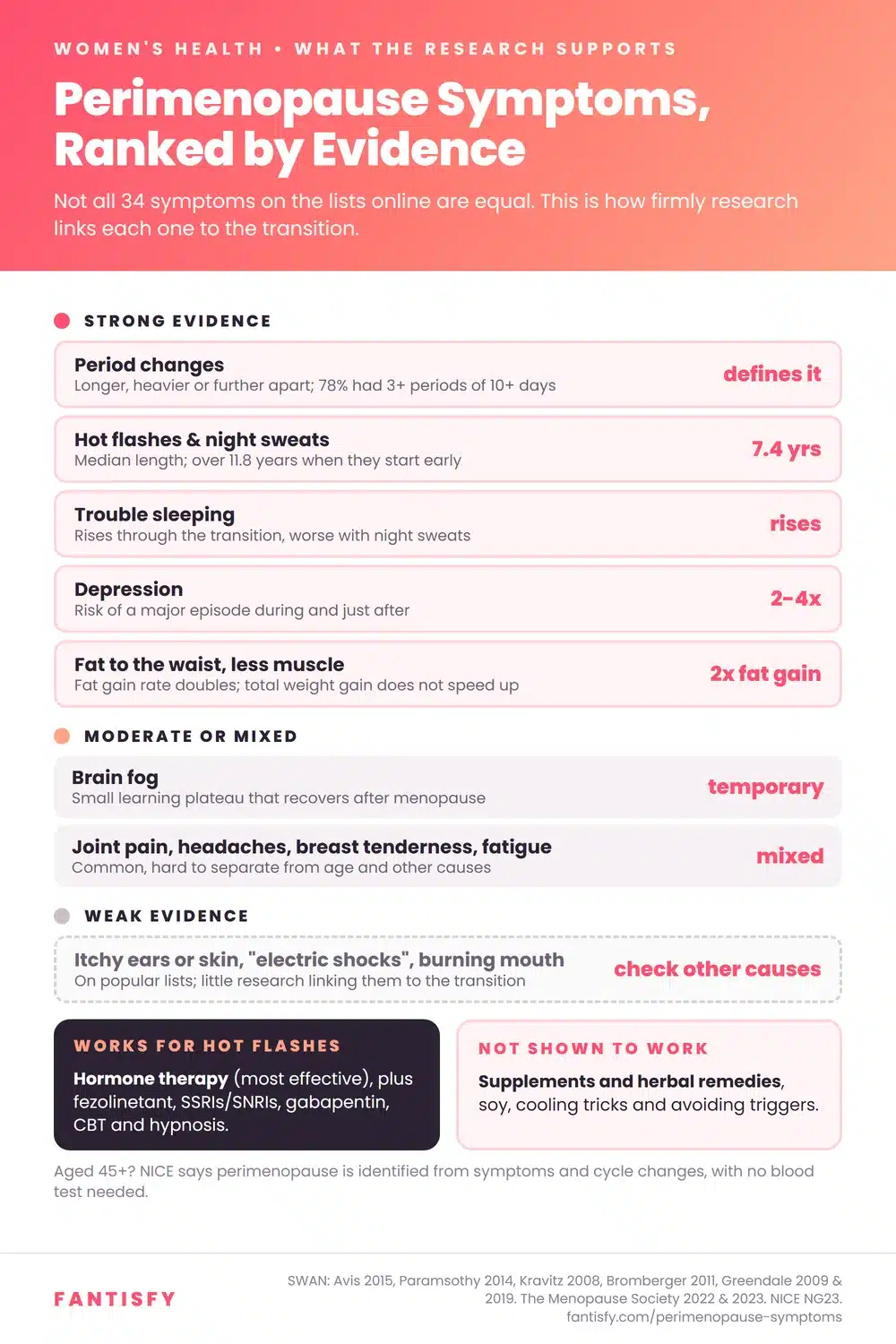
Not every symptom attributed to perimenopause has the same weight of evidence behind it. This is the list sorted by how firmly the research links each one to the transition itself, rather than to getting older or to something else.
| Symptom | What the research shows | Evidence |
|---|---|---|
| Period changes | Defines the stages; in SWAN, 78% of women had three or more periods lasting 10 days or longer | Very strong |
| Hot flashes and night sweats | Median duration 7.4 years; the symptom hormone therapy treats best | Very strong |
| Trouble falling and staying asleep | Rises through the transition, worse with more frequent night sweats | Strong |
| Depression | Two to four times the risk of a major depressive episode during and just after the transition | Strong |
| Fat moving to the waist, muscle loss | Fat gain doubles in rate and lean mass falls from the start of the transition | Strong |
| Brain fog | Small, measurable plateau in learning and memory that recovers after menopause | Moderate |
| Vaginal dryness, painful sex | Part of the genitourinary syndrome of menopause; tends to increase after the final period | Strong, mostly later |
| Joint pain, headaches, breast tenderness, fatigue | Commonly reported; harder to separate from age and other causes | Mixed |
| Itchy skin or ears, tingling, “electric shocks”, burning mouth | Appear on popular online lists; little research linking them specifically to the transition | Weak |
A weak rating does not mean the symptom is imaginary. It means it has not been studied well enough to say perimenopause is the cause, which matters because other treatable conditions, such as thyroid problems, iron deficiency and depression, produce several of the same complaints in the same age group.
Hot Flashes and Night Sweats
Hot flashes, and their night-time version, night sweats, are the signature symptom, and SWAN measured how long they really last. Among women with frequent hot flashes, the median total duration was 7.4 years, and they continued for a median of 4.5 years after the final period.
When they start matters a great deal. Women whose frequent hot flashes began while they were still having regular periods, or early in the transition, had them for a median of more than 11.8 years. Women whose hot flashes only began after their final period had them for a median of 3.4 years. African American women reported the longest duration of any group, a median of 10.1 years.
That is the most useful number to have if you are deciding whether to wait them out. For many women, waiting means most of a decade, which is why treatment deserves a real conversation rather than a shrug.
Period Changes: What Is Normal
Irregular periods are expected, and SWAN’s bleeding study shows how irregular “expected” can be. Over the transition:
- 78% of women had at least three periods lasting 10 days or longer.
- 67% had at least three episodes of spotting lasting 6 days or more.
- 35% had at least three episodes of heavy bleeding lasting 3 days or more.
Uterine fibroids, hormone use and a higher body mass index were all linked with more of these changes. Common does not mean it should be ignored, though. The American College of Obstetricians and Gynecologists lists these as not normal, even during perimenopause, and worth an appointment: bleeding or spotting between periods, bleeding after sex, heavy bleeding, bleeding that is heavier or lasts longer than usual, and any bleeding after menopause. Most of the time the cause is benign, such as polyps or a thin uterine lining, but abnormal bleeding can also be an early sign of uterine cancer, so it needs checking.
Sleep and Mood
Sleep. In SWAN, the odds of difficulty falling asleep and staying asleep rose through the transition, and more frequent hot flashes were linked with more of every kind of sleep problem. Falling estrogen and rising follicle-stimulating hormone were each linked with worse sleep. Women using hormone therapy after menopause generally reported less disturbed sleep. Night sweats are often the direct cause, which is why treating them tends to help sleep too. For the part of sleep that matters most and how to protect it, see how to get more deep sleep.
Mood. This is the symptom most often underplayed. SWAN found women were two to four times more likely to have a major depressive episode during perimenopause or in the early years after menopause than before it. The effect held after accounting for a history of depression, stressful life events, hot flashes and hormone levels. A past episode of depression was still a strong predictor, so if you have had depression before, this is a time to watch for it closely.
Brain Fog
The forgetfulness is real and it is measurable. SWAN tested 2,362 women’s memory and processing speed over four years. Before and after the transition, women’s scores improved with practice, the way anyone’s do on a repeated test. During perimenopause, that improvement stalled: women did not learn as well as they had before. After menopause, it came back, and postmenopausal women not on hormones performed the same as premenopausal women.
A 2024 review in Menopause puts it in proportion: the decline is small, not explained by age alone, and stays within normal limits for all but a very small number of women. In its usual form, perimenopausal brain fog is not a sign of dementia. If memory problems are severe, getting worse, or affecting your work or safety, that is a reason to see a doctor, because it is not the usual pattern.
Weight and Body Shape
Here the research contradicts the usual story. SWAN tracked body composition through the transition and found that weight itself did not start rising faster at perimenopause. It had been climbing steadily through the premenopausal years and simply continued.
What changed was what the weight was made of. At the start of the transition the rate of fat gain doubled and lean mass began to fall, and both continued until about two years after the final period before leveling off. So the scale can look much the same while your clothes fit differently, with more fat around the middle and less muscle.
That points at what to measure and what to do. The waist-to-height ratio calculator tracks the fat shift better than weight does, and the lean body mass calculator shows the part you are trying to keep. Strength training and enough protein are the main levers for holding on to muscle; the protein calculator gives a target for your size.
The “34 Symptoms” List and Hormone Tests
The widely shared list of 34 perimenopause symptoms is not a medical classification. It does not come from the STRAW+10 staging system, from The Menopause Society (formerly NAMS), or from NICE. It mixes symptoms with strong evidence, such as hot flashes and irregular periods, with ones that have very little, such as itchy ears and a burning tongue. It is useful for one thing: realizing that a strange new symptom might be connected. It is not useful for deciding that it is.
The same caution applies to hormone testing. NICE advises that for women aged 45 or over, perimenopause should be identified without laboratory tests, and specifically says not to use anti-Müllerian hormone or inhibin A tests to identify it. It suggests a follicle-stimulating hormone (FSH) test only in narrower cases: to help confirm menopause in women aged 40 to 45 with symptoms and cycle changes, and in women under 40 when early menopause is suspected. It also says an FSH test does not work for women using combined hormonal contraception or high-dose progestogen. Because hormone levels swing from week to week in perimenopause, a single test can look normal on the day and change nothing about your diagnosis or treatment.
What Actually Helps, Ranked
The two position statements from The Menopause Society, on hormone therapy in 2022 and on non-hormone options in 2023, grade every common treatment for hot flashes by the strength of its evidence. Their conclusions, for hot flashes and night sweats specifically:
| Rank | Treatment | Verdict |
|---|---|---|
| 1 | Hormone therapy | The most effective treatment. Benefit outweighs risk for most women under 60 or within 10 years of menopause without contraindications; also prevents bone loss |
| 2 | Fezolinetant (a non-hormonal prescription) | Recommended, strongest level of evidence |
| 2 | SSRIs, SNRIs, gabapentin | Recommended, strongest level of evidence |
| 2 | Cognitive behavioral therapy, clinical hypnosis | Recommended, strongest level of evidence |
| 3 | Oxybutynin; weight loss | Recommended, with weaker evidence |
| Not recommended | Supplements and herbal remedies, soy, cannabinoids, acupuncture | Not shown to reduce hot flashes |
| Not recommended | Cooling techniques, avoiding triggers, exercise, yoga, paced breathing | Not shown to reduce hot flashes |
Two things to read carefully in that table. First, “not recommended” is about hot flashes only. Exercise is excellent for your heart, bones, mood and sleep; it just has not been shown to cut hot flashes. Second, the most heavily marketed products for perimenopause, the supplements, are in the not-recommended row. If you have spent money on them without relief, that is what the evidence would predict.
On hormone therapy, the 2022 statement is specific about timing: for women under 60 or within 10 years of menopause and with no reason to avoid it, the balance of benefit and risk is favorable for bothersome hot flashes. Started later than that, the balance is less favorable because the absolute risks of heart disease, stroke, blood clots and dementia are higher. The right choice depends on your own history, which is a conversation for a clinician who knows it.
When to See a Doctor
Book an appointment if any of these apply:
- Bleeding between periods, after sex, or heavier or longer than usual, or any bleeding once you have gone 12 months without a period.
- Low mood that lasts two weeks or more, loss of interest in things you normally enjoy, or thoughts of self-harm. If you are in the US and in crisis, call or text 988.
- Symptoms before 40, or before 45 with periods stopping. Early menopause has its own long-term health implications and is worth confirming.
- Hot flashes or night sweats that disrupt your sleep or work. Effective treatments exist, and waiting can mean years.
- Memory problems that are severe or getting worse, which is not the usual pattern.
One more thing that is easy to forget: you can still get pregnant during perimenopause, because ovulation continues on and off until the final period. If pregnancy is not something you want, keep using contraception until a clinician confirms you are through menopause.
Key takeaways:
- At 45 or over, perimenopause is diagnosed from symptoms and cycle changes, not a blood test.
- Hot flashes last a median of 7.4 years, and over 11.8 years when they start early.
- The risk of major depression is two to four times higher during and just after the transition.
- Weight gain does not speed up, but fat moves to the waist and muscle declines.
- Hormone therapy works best for hot flashes; menopause supplements have not been shown to work.
The Verdict
The perimenopause symptoms with real evidence behind them are a short list: changing periods, hot flashes and night sweats, broken sleep, a higher risk of depression, a small and temporary dip in memory, and fat shifting to the middle while muscle declines. The longer lists online add plenty that has never been properly linked to the transition, and some that deserve a check for something else.
What the research is clearest on is that you do not need to guess or wait. If you are 45 or older, your symptoms are the diagnosis. Hot flashes often last most of a decade, and hormone therapy and several non-hormonal prescriptions reduce them, while the supplements aimed at this market have not been shown to. Track your cycle, note what is changing, and take the list to a clinician who treats menopause.
If sleep is the symptom wearing you down most, the evidence on protecting the deepest stage of it is in how to get more deep sleep.
FAQs
Citations
Gold EB, Crawford SL, Avis NE, et al. Factors related to age at natural menopause: longitudinal analyses from SWAN. American Journal of Epidemiology, 2013. pubmed.ncbi.nlm.nih.gov
Harlow SD, Gass M, Hall JE, et al. Executive summary of the Stages of Reproductive Aging Workshop + 10: addressing the unfinished agenda of staging reproductive aging. Fertility and Sterility, 2012. pubmed.ncbi.nlm.nih.gov
Avis NE, Crawford SL, Greendale G, et al. Duration of menopausal vasomotor symptoms over the menopause transition. JAMA Internal Medicine, 2015. pubmed.ncbi.nlm.nih.gov
Paramsothy P, Harlow SD, Greendale GA, et al. Bleeding patterns during the menopausal transition in the multi-ethnic Study of Women’s Health Across the Nation (SWAN). BJOG, 2014. pubmed.ncbi.nlm.nih.gov
Kravitz HM, Zhao X, Bromberger JT, et al. Sleep disturbance during the menopausal transition in a multi-ethnic community sample of women. Sleep, 2008. pubmed.ncbi.nlm.nih.gov
Bromberger JT, Kravitz HM, Chang YF, et al. Major depression during and after the menopausal transition: Study of Women’s Health Across the Nation (SWAN). Psychological Medicine, 2011. pubmed.ncbi.nlm.nih.gov
Greendale GA, Huang MH, Wight RG, et al. Effects of the menopause transition and hormone use on cognitive performance in midlife women. Neurology, 2009. pubmed.ncbi.nlm.nih.gov
Maki PM, Jaff NG. Menopause and brain fog: how to counsel and treat midlife women. Menopause, 2024. pubmed.ncbi.nlm.nih.gov
Greendale GA, Sternfeld B, Huang M, et al. Changes in body composition and weight during the menopause transition. JCI Insight, 2019. pubmed.ncbi.nlm.nih.gov
The North American Menopause Society. The 2022 hormone therapy position statement of The North American Menopause Society. Menopause, 2022. pubmed.ncbi.nlm.nih.gov
The North American Menopause Society. The 2023 nonhormone therapy position statement of The North American Menopause Society. Menopause, 2023. pubmed.ncbi.nlm.nih.gov
Lederman S, Ottery FD, Cano A, et al. Fezolinetant for treatment of moderate-to-severe vasomotor symptoms associated with menopause (SKYLIGHT 1): a phase 3 randomised controlled study. The Lancet, 2023. pubmed.ncbi.nlm.nih.gov
National Institute for Health and Care Excellence. Menopause: identification and management (NG23), recommendations 1.3.1 to 1.3.6. nice.org.uk
American College of Obstetricians and Gynecologists. Perimenopausal Bleeding and Bleeding After Menopause (FAQ162, reviewed February 2024). acog.org




Leave a Reply